
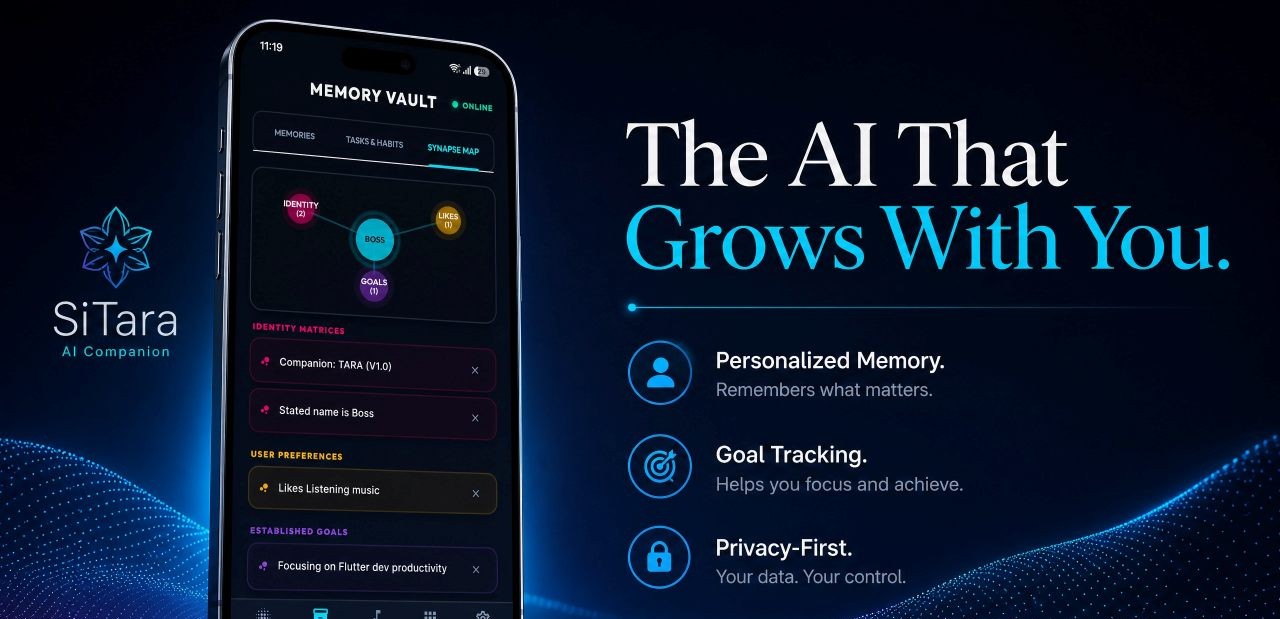
Project SiTARA
System-Integrated Tactical Agentic Reasoning Assistant
Engineering a 100% local, cross-platform vision-agentic AI assistant for Android, iOS, Windows, and macOS. This is our ongoing flagship product effort and a focused 90-day architecture sprint to remove the legacy trade-off between privacy and intelligence.
1. Executive Summary and Product Vision
Over the last three months of continuous development, our team has focused on a single mission: eliminating the most painful compromise in modern AI systems - choosing between privacy and capability.
Most cloud-dependent assistants introduce network latency, create reliability gaps when connectivity drops, and route sensitive context through third-party infrastructure. Project SiTARA is designed to solve this at the architecture level by bringing real assistant-grade intelligence directly onto host devices.
SiTARA is being built as a unified local AI ecosystem that combines quantized open LLM inference, multimodal vision agents, low-latency offline voice interaction, and persistent active retrieval - all executed locally on supported hardware without mandatory cloud dependency.
2. Key Architectural Innovations and Breakthroughs
Cross-Platform Native Engine (Android, iOS, Desktop)
SiTARA does not depend on webview wrappers or Electron-heavy pathways for critical inference. The product uses a C++ native execution core connected to hardware-optimized paths per operating system:
- Android: NDK-based native runtime with GGML/llama.cpp, optimized for ARM v8.4-A vector instructions and Snapdragon NPU-aware acceleration paths.
- iOS: Metal Performance Shaders and CoreML bindings for low-overhead execution with unified memory on Apple Silicon.
- Desktop (Windows/macOS): Dynamic compute offloading through CUDA, DirectML, and Metal depending on available hardware.
Always-On "Hey Tara" Voice Pipeline
Delivering an always-listening assistant without unacceptable battery drain required a two-stage offline cascade:
- Stage 1 - Micro-Acoustic Classifier: A lightweight ~150 KB DSP wake detector running in a low-power loop (targeting below 1% battery impact over 8 hours).
- Stage 2 - Local Transcription and Verification: On wake trigger, Faster-Whisper (INT8) is activated for fast local speech decoding with sub-500 ms response targets.
- Local Response Synthesis: Piper TTS generates natural offline spoken responses in real time.
On-Device Vision Agentic Intelligence
SiTARA is designed for actionable perception, not text-only prompt response:
- Desktop Screen Intelligence: Local parsing of GUI state, logs, forms, and web layouts directly from captured frames without remote upload.
- Mobile Camera Vision: Quantized on-device VLM execution for document understanding, receipt scanning, and real-world hardware analysis.
- Actionable Automation Layer: The vision agent maps interpreted intent to native UI coordinates and system events for multi-step task execution.
Active Context Search and On-Device RAG
To enable durable memory without cloud vector databases, SiTARA uses an embedded local retrieval stack:
- Vector Indexing: SQLite-vec / HNSW-style local indexing with 384-dimensional embeddings.
- Continuous Active Retrieval: Background indexing across local documents, notes, system files, and prior session context.
- Reasoning-Time Injection: Relevant historical context is inserted into the agent loop before execution to improve continuity and task quality.
Native Multi-Language Intelligence
The language layer is designed for real-world multilingual usage patterns, including mixed-language commands. SiTARA supports multiple languages and regional dialect scenarios, with local speech recognition and translation pipelines for context-preserving conversational flows (including hybrid inputs such as Hinglish).
Phone-First Practical Assistant Capabilities
On mobile, SiTARA is being engineered as a true day-to-day execution assistant, not just a chat interface. It is designed to understand natural voice or text intent and convert it into actionable on-device workflows.
- Capture and organize quick notes instantly.
- Open apps and navigate common in-app flows with minimal manual input.
- Draft or send messages using contextual voice commands.
- Play songs, control playback, and manage media actions hands-free.
- Create reminders, schedule follow-ups, and track pending tasks.
- Chain multiple intents into one request (for example: "open calendar, add reminder, and message the team").
The goal is a reliable personal execution layer that can handle dozens of practical micro-tasks every day while keeping user context local and private.
3. 3-Month Sprint Progress and Timeline
[MONTH 1: Foundation] ----> [MONTH 2: Vision and Voice] ----> [MONTH 3: Multi-Platform RAG]
 • GGUF Quantization          • "Hey Tara" Wake Engine         • SQLite-vec On-Device RAG
 • C++ Core Execution         • Faster-Whisper + Piper TTS     • Android/iOS Native UI
 • Snapdragon/Apple SoCs      • Local VLM Screen Parsing       • Multi-Language Pipelines
Month 1 (Core Engine): Integrated quantized GGUF models directly into desktop and mobile runtimes and established sub-second local token generation in controlled flows.
Month 2 (Multimodal Expansion): Deployed low-power "Hey Tara" wake listening and integrated local vision models for both screen understanding and camera pathways.
Month 3 (Active RAG and Platform Synergy): Finalized local vector integration, aligned Android+iOS+Desktop code paths, and tuned agentic execution loops for practical multi-step tasks.
4. Technical Stack at a Glance
| Component | Technical Implementation |
|---|---|
| Inference Core | GGML / llama.cpp (GGUF quantization including Q4_K_M and Q8_0 profiles) |
| Speech-to-Text | Faster-Whisper (INT8 quantized) |
| Text-to-Speech | Piper neural speech engine |
| Vision Model Layer | Quantized visual language models (VLMs) for screen and camera workflows |
| Vector Engine | SQLite-vec with on-device cosine similarity search and active retrieval indexing |
| Supported OS | Android, iOS, Windows, macOS |
| Acceleration Paths | Snapdragon NPU pathways, Apple Metal/MPS/CoreML, CUDA, DirectML, Metal |
| Execution Philosophy | Privacy-first, local-first, offline-capable agentic orchestration |